

Have you ever woke up one day to realize that you’re no longer being fulfilled by the work you do? It doesn’t necessarily happen all at once, but shows up in tiny moments of your day. You have a little resistance, a little fatigue, maybe a lot of procrastination, and then you hear a little whisper saying, “I don’t really like what I’m doing anymore.”
So you sit and reflect, and there comes a quiet, subtle, but impossible to ignore realization that the version of you who built your business is not the version of you standing here today. And that’s why it doesn’t feel “right” anymore.
That was me not too long ago, which created this long-awaited shift for me. To understand where I am today, you have to understand where I started. To give you a little backstory, in 2019, I got really serious about changing the way I was living. I had moments years before where I knew I was meant for more and pushed harder to be a better person. I was furthering my education, had a good job, and started therapy. I was doing a lot, but let’s face it…l was working a minimum of 50 hours a week, and I decided to be an overachiever and take an accelerated program to get my Master’s of Business Administration (MBA). If that wasn’t enough, I graduated in August of 2015 and decided to start another Master’s program for Health and Wellness Coaching in August of 2015, too. You know, who needs a break between master’s degrees?! But that’s the person that I was. It was the identity that I was creating – the driven, go-getter, who wasn’t stopping.
I was the person who kept going. I finished my second Master’s degree, and ended up running 3 businesses in a period of 3 years, one being C Clark Consulting (C3) in August of 2017. C3 became what I deemed as successful. I started off earning more than I ever had, I was able to apply my education to what I was doing (who can say that too often these days), and I was loving it. It was challenging in so many ways, but I was meeting new people, supporting nonprofits, and having experiences that I (nor anyone in my family) had ever had before. I felt like I was really making something of myself.
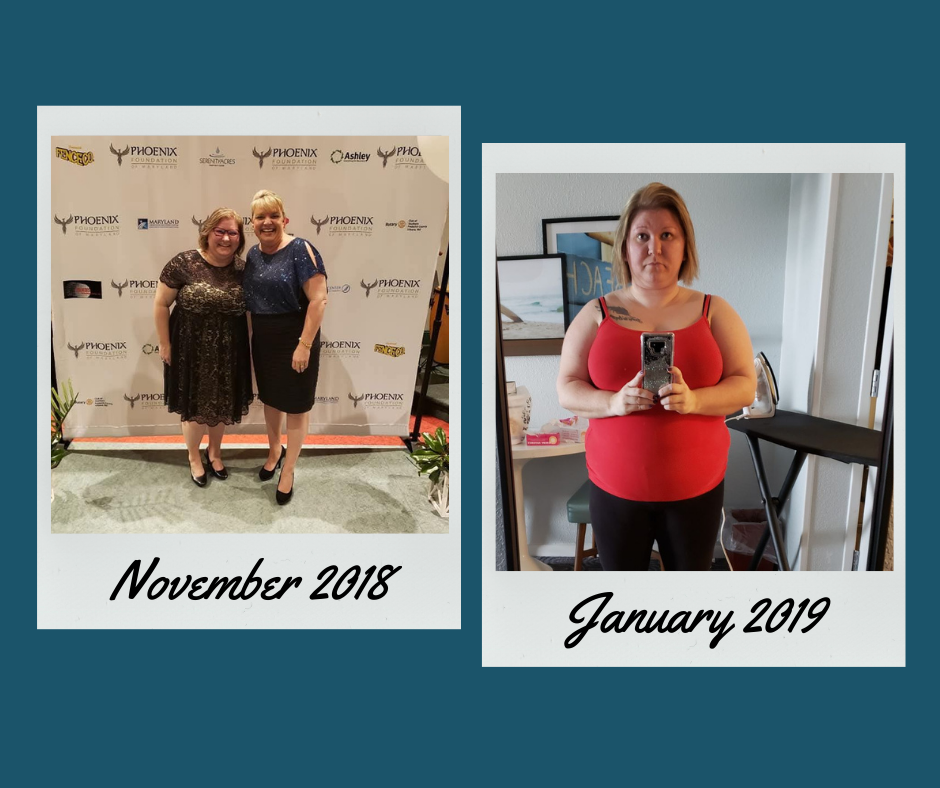
And then 2019 hit. I made it a point to go away every New Year’s Eve, and that year, I spent it in Ocean City. I literally woke up January 1, 2019, and thought, “What am I doing?!?!” I was miserable. You see, the picture below, on the left, is me and my best friend at a gala supporting one of my favorite nonprofits, Phoenix Recovery Academy. That was in November of 2018. I was smiling and laughing. While I always have a blast with Dawn, I felt like I was dying on the inside. The picture on the right is a more accurate depiction of what I really felt like. That is me on that New Year’s day, finally having enough. If I could sum up the way I felt, it was that I was holding all of these things in – thoughts, feelings, emotions, past hurt, familial stuff that did and didn’t “belong” to me. It was heavy. I felt like I was going to burst if I didn’t do something about it, and quite frankly, I looked like I was going to burst, too. I was simply miserable. Something had to change, so I committed to working on myself since I felt like my business was stable enough.
As I mentioned, I had a good job working crazy hours. In that role, I was introduced to HubSpot, and without knowing it, that shaped the entire foundation of C3. When I launched my business, HubSpot gave me something every new entrepreneur desperately craves: structure, clarity, and legitimacy.
It taught me how to build inbound systems, nurture leads, manage pipelines, and speak the polished language of business-to-business (B2B). It showed me how to be strategic, data-driven, and relatable. All the things I thought a “real” business owner needed to be.
And in a season where my personal life felt chaotic and heavy, HubSpot gave me something to hold onto professionally, and they were really big on marketing in a human way, so it felt good. I stepped into the identity that HubSpot reinforced: the strategist, the operator, the B2B consultant who always had the plan.
That identity carried me for years. Until it didn’t.
Looking back, I now see that my business identity wasn’t really a brand; it was a role I created to survive.
It was the identity of someone who believed she had to prove herself in every room she entered because she wasn’t worthy of these new experiences. Someone who didn’t feel like she could bring her whole self because she would be shamed for sharing her true experiences. Someone who relied on structure because her internal world was unraveling.
My business identity was built around being:
HubSpot didn’t create this identity, but it supported it. It gave me the tools to perform that version of myself. And for a while, it worked.
I had attended many professional development seminars and conferences, and they helped, for the most part. At least until I realized that most of them were repeating the same information in different ways, and that I can do all the things professionally, but until I really got myself sorted out, I was going to keep getting the same result. And then I went to PSI Seminars’ basic training for a weekend, and WOW! Cortland Warren was our facilitator, and he said some things that really hit hard and that I will never forget. I took two major things from that weekend:
That weekend helped me start to take accountability for myself. It just happened to be in December of 2018, and I truly believe this was the spark that made me wake up that day, knowing the time for me to start changing was then.
Here’s where things got complicated. While I was doing deep personal healing: different therapy modalities, reflection, lots of inner child work, more personal and professional development retreats – my business continued to display the older version of me to the world.
Internally, I was becoming more intuitive, more conscious, more connected, more aware.
Externally, I was still showing up as the “I mean business” strategist.
I didn’t see it then, but I was living in two identities: The woman I was becoming and the woman my business was built around. The woman I was becoming was warm, showed depth, and was inviting. The one I had been was cold, closed off, and surface-level if I’m being honest. The gap between those two versions of me started widening…fast.
The signs were subtle at first. They were easy to shrug off, easy to explain away. Until one day, they weren’t subtle anymore. I started noticing things like:
After years of personal development, I knew for certain that I wasn’t going back to the person that I was, and it was time for my business to change. I had evolved, and that mismatch was costing me my energy, my joy, and my clarity.
Once I saw the misalignment, I couldn’t unsee it. I slowly began shifting. Not by blowing up my business, but by letting myself be more honest inside it. I still had to make a living, but I knew a big shift was coming.
So, I got really clear about my values and the way I wanted to be known. I also got very honest with myself about what value I brought to business and what services I was offering just because they were easy or expected of me, since I had been offering them for years. I got clear about what I really wanted to offer and what the intended end result was.
I asked a good friend to refresh my brand, made it a point to hire a photographer for a branding shoot, and I had 3 amazing women who had been a part of this growth journey do the photoshoot with me. I got the new look, and then I sat with it for 7 months. Yes, 7 more months, which by this point made it a 6+ year journey.
Around this time, I also began realizing that even the name of my business no longer fit who I was becoming, but I didn’t yet have the language for what it was evolving into.
Here’s the part many entrepreneurs never talk about: Even when you know you’ve outgrown your business identity…the idea of changing direction is terrifying.
I remember thinking:
Fear will always try to convince you to stay in the identity that feels familiar, even when that identity is no longer yours to carry. But at some point, staying becomes more painful than shifting.
There comes a moment in every evolution where your intuition makes the call long before your strategy does.
For me, it was undeniable. My body knew before my mind caught up. There was a quiet knowing that said: “You’re not meant to stay here.” Earlier this year, I even took a leap of faith and fully launched a nonprofit, Amplified Change, that I had been sitting with for at least 6 years. I had no idea that the nonprofit endeavor would push me even more to evolve C3. It was showing all the ways I had grown in real time and showing me more and more that the way I was running C3 needed to change. I kept putting the launch of my new brand and direction off and putting everyone else’s business in front of mine. Until the whispers came like brick walls that I couldn’t deny.
I started to take a lot of time alone, and I got this idea of the C3 Leadership Mirror™, which was everything I had already known, experienced, and had been teaching, wrapped up into one tool.
As I spent more time listening inward, something else became clear: the work I was doing was no longer about optimizing one side of the business. It was about integration.
The individual and the business.
The inner world and the outer systems.
Awareness and action.
That’s when the name Coalesce Coaching & Consulting surfaced. Coalesce means to bring separate parts into a unified whole. And for the first time, the name matched the work.
The creation of the C3 Leadership Mirror™ was a culmination, not a pivot.
And then I got the whisper: “This is what you’ve been waiting on. The time is now.”
Trusting that whisper changed everything.
Not because I had the perfect plan.
Not because I had everything figured out.
But because I chose alignment over fear.
I chose to stop performing the identity I had outgrown and start embracing the person I am becoming.
In the next blog post, I’m going to talk about: “Why changing direction isn’t failure. It’s alignment”.
Because that’s the truth most entrepreneurs forget:
You don’t outgrow your business identity because something is wrong.
You outgrow it because something is right.